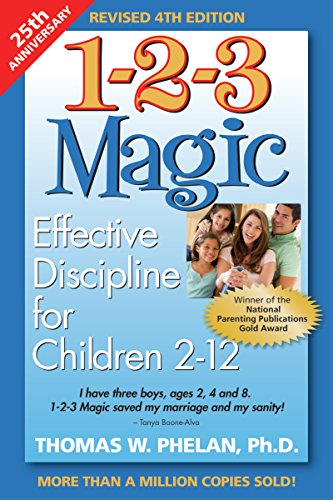
This revised edition of the award-winning 1-2-3 Magic program addresses the difficult task of child discipline with humor, keen insight, and proven experience. The technique offers a foolproof method of disciplining children ages two through 12 without arguing, yelling, or spanking. By means of three easy-to-follow steps, parents learn to manage troublesome behavior, encourage good behavior, and strengthen the parent-child relationship—avoiding the "Talk-Persuade-Argue-Yell-Hit" syndrome which frustrates so many parents. Ten strategies for building a child’s self-esteem and the six types of testing and manipulation a parent can expect from the child are discussed, as well as tips on how to prevent homework arguments, make mealtimes more enjoyable, conduct effective family meetings, and encourage children to start doing their household chores. New advice about kids and technology and new illustrations bring this essential parenting companion completely up-to-date.
"An excellent, workable, and supportive resource for parents and educators." —Booklist
is a clinical psychologist and a nationally renowned expert on child discipline and attention deficit disorder. His books include
1-2-3 Magic for Teachers, All About Attention Deficit Disorder,
and
Surviving Your Adolescents. He lives in Glen Ellyn, Illinois.
Most helpful customer reviews
385 of 403 people found the following review helpful.
 Changed my life!
By Stephanie
I have a really independent and strong willed little girl who is pretty sure she knows everything already and is in charge of the home. I also inherited a bad, bad temper from my own father, and a set of unproductive and rage-fueled methods for handling discipline in the home. I was terrified I would squelch my daughter's independence and irreparably damage our relationship, until I read this amazing book. It's a simple, incredibly effective technique that gives parents a rapid response to quietly and calmly shut down any obnoxious behaviour, along with encouragement to provide constant positive reinforcement and love. It has revolutionized my relationship with my daughter, who now knows exactly where the boundaries lie and what to expect when she violates them. I haven't slammed a door since I read the book, and I no longer fear that I'm perpetuating a cycle of anger and harsh punishment. Highly recommend it.
108 of 129 people found the following review helpful.
A MUST read for every parent
By Jerry FLA
My son will be 12 in a couple of weeks and he still instantly responds whenever he sees a my index finger. I first read this book and put it into action when my son was probably between 4 and 5 years old.
My wife never read this book but saw the amazing results I was getting and I soon heard her saying "one... two...". Neither one of us has gotten to "three" since establishing the 'baseline' when we first started using this system.
Here's basically how we put it to work: When our boy misbehaved I held up one finger and said "one". He had a second chance "two" but at three he got an instant 5 minute time out.
My son found those 5 minutes excruciating and figured out VERY quickly that:
1. He received consistently INSTANT punishment at "three".
2. His punishment time was extended for "bad behavior" while in time out.
3. Most importantly, he figured out he had the ability to avoid any consequences by modifying his behavior.
Fast forward 8 or so years to the present. My son has never been spanked or otherwise punished physically. He just got another straight A report card - his usual since he started school. The comment I hear most often from his teachers is that he is a "joy" in the classroom. He's polite and kind and no pushover either: he just earned a second level karate black belt.
I could go on for an hour but needless to say he's turning out to be an amazing person.
I still use the system but nowadays it's usually a discreet flash of a "one" or perhaps a "two" to let him know a course change is recommended. The only "three" he has seen in years is fair warning that his dad is about to pounce on him and tickle him until he begs for mercy.
Of course my wife (who never did read the book) will still yell "TWO" when she wants him to do something - but it still works for her.
Finally, use this book - it worked for my family. My only advice is to be certain to "set down the rules" early and consistently and then let your kid decide what course they take.
UPDATE Summer 2014:
Well, my son will be getting his driving permit soon and he qualified for placement in the "advanced technology" program in school having transferred with a 4.0 from private school. This young man is destined for success. I attribute his school success with the fact that his mother spent literally hours with him every evening working on homework. At this point he has developed excellent study skills that will serve him well.
As for behavior, he is a wonderful young man (and typical 15 year old). I am convinced that the 1-2-3 method - actually the idea of the method - has been instrumental in his becoming who he is. The idea of course, is that you are not forcing behavior but allowing the child to learn to make advantageous choices. THAT's the important message of this book.
Today I see my son making choices all day long (as we all do) but he (usually) consciously weighs the pro/cons and options before taking action. He truly is a joy to watch as he gets older. And I still squeeze him when I get the chance.
260 of 321 people found the following review helpful.
 Undertones of disrespect in an otherwise valuable system
By N V-meyer
As a public school teacher and a mother (2 preschoolers and an infant), I struggled with this book. While I find some incredibly valuable principles in the 1-2-3 Magic system, there are several underlying assumptions (some of which are stressed repeatedly by the author) that don't sit well with me at all.
WHAT I DIDN'T LIKE
-Dr. Phelan describes 3 major parenting jobs: 1. Controlling obnoxious behavior, 2. Encouraging good behavior, and 3. Strengthening the parent-child relationship. This feels backwards. It seems to me that these three jobs ought to be prioritized and implemented in reverse order, because a child who feels loved and secure will naturally exhibit less obnoxious behavior.
-Dr. Phelan repeatedly warns parents against thinking of children as "little adults" who will act cooperatively if they have the proper information and sound reasoning, but instead suggests visualizing ourselves as "wild animal trainers." (Are adults all predisposed to cooperation based simply on years??) I will readily admit that my home sometimes sounds like a zoo. However, my children (even at ages 2 and 4) demonstrate to me over and over again the depth and beauty of their spirits, and the complexity of their thoughts and emotions. I want to foster an environment in which my children know that their feelings matter to me, and in which respect grows out of love and trust rather than effective crowd control.
-In an attempt to keep things light and humorous, Dr. Phelan's directions to parents sometimes come across as condescending. For instance, he describes a scenario in which "dad asked the world's dumbest question, 'What's going on in here?'" Levity can be achieved without resorting to insults and sweeping generalizations. Furthermore, I believe this kind of rhetoric will pass right down into the parenting if the parent follows Dr. Phelan's system without challenge.
WHAT I LIKED
-My favorite thing about the "no talking, no emotion" system is that it keeps kids' little mistakes little. Sometimes in the exasperated moments of parenting I find myself saying things like, "C'mon guys! Can't you see that I'm...." or "Why can't you just..." A simple and clear "Too loud. Strike one." gives my 4-yr-old a chance to change his behavior without feeling like he's ruined mommy's day. He frequently apologizes immediately and peace is restored. It also removes the unnecessary vocabulary and verbosity that can overwhelm my 2-yr-old.
-The distinction between "stop behaviors" (fighting, whining, jumping on the bed) and "start behaviors" (getting dressed, brushing teeth, finishing dinner) was a big light-bulb moment for me. Separating the tasks at hand into these two categories has drastically simplified my instructions.
-The use of timers is very helpful as it removes all the parent-child tension from "start behaviors" like finishing dinner. There are no longer arguments about whether or not my 2-year-old should get dessert after taking 97 minutes to down a single serving of veggies. The timer does the talking, and nobody can argue with the timer.
-One-on-one time with each kid is such an overlooked necessity. Just as my husband and I feel like passing ships when we don't manage to squeeze in a date together for months at a time, my kids must experience that same kind of relational depletion when they get lost in the endless whole-family activities.
Overall, I am grateful for the bits that I am able to apply effectively, but I prefer to build my parenting philosophy on a different foundation. Out of the stack of parenting books I recently checked out of the library (including this one), I'd sooner recommend "How to Talk So Kids Will Listen and Listen So Kids Will Talk."
See all 441 customer reviews... 
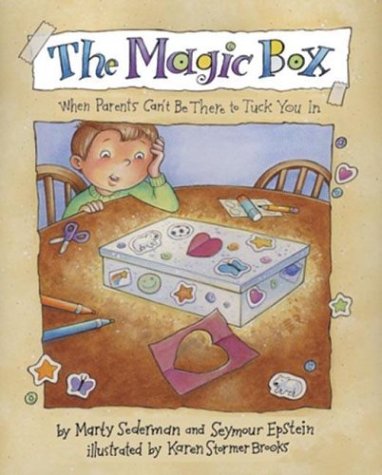
 Help kids stay connected while you're away with Magic Box